[컴선설] Lec 03 Bezier Curve
[컴선설] Lec 03 Bezier Curve
1. Parametric Curve
Types of function
- Explicit function : $y=f(x)$ : open
- Implicit function : $f(x, y) = 0$ : closed
- Parametric function : $f(t)$ : function of time $t$ (auxiliary variable)
Parametric curve
- Express high-dimensional space with time $t$
2. Polynomial basis
Bernstein basis
- sum-to-one property : summing up all basis with same degree = 1
- Degree : 1
- $B_0^1(t) = (1-t) , B_1^1(t) = t$
- Degree : 2
- $B_0^2 = (1-t)^2, B_1^2 (t) = 2(1-t) t, B_2^2(t) = t^2$
- Transform monomial form to Bernstein form : compare coefficients
Sketch Curve using Bernstein basis coefficients
- Ex) $f(t) = 2(1-t)^3 + {10 \over 3}3(1-t)^2t+ {8\over 3} 3(1-t)t^2+3t^3$
- $b_0 = 2, b_1 = {10\over 3}, b_2 = {8\over 3}, b_3 = 1$
- Graph $C(t)$
- Four control points
- $t = \sum_{i=0}^3{i\over 3}B_i^3(t)$
- Example!
3. Bezier curve
- To draw bezier curve with control points
- Each coefficient is control point on the plane
4. De Casteljau algorithm
- Method of finding POC on bezier curve without using formula
- to determine point with time $t$,
- Divide with ratio $t:1-t$, and iterate
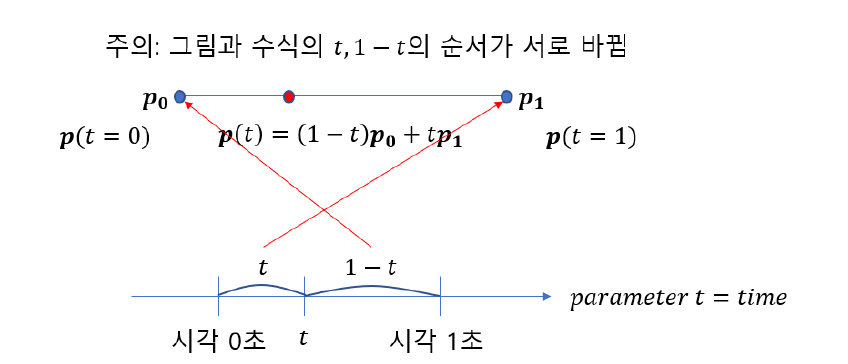
- $P(t) = (1-t)p_0 + tp_1$
- For division, apply $t:1-t$
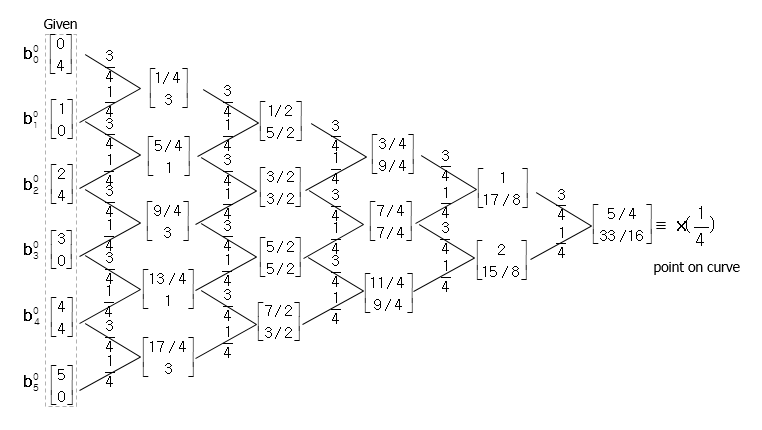
- For computing with given points, must perform $(1-t)P_{\text{left}} + tP_{\text{right}}$
1
2
3
4
<decas>
for r = 1 < n :
  for i=0 < n-r :
    coeff[i] = (1-t) coeff[i] + t coeff[i+1]
Convex hull property
- Convex polygon that covers all points in given plane
- Every POC is located interior of convex hull generated by Control Points
Endpoint interpolation
- The first control point($\bf b_0$) is the POC when time $t=0$
- The last control point($\bf b_n$) is the POC when time $t=1$
Variation Diminishing
- Number of variation(변곡) of polygon ≥ Number of variation of Bezier curve
5. Bezier Basis Function
- To obtain a specific basis function in a Bezier curve, set the value of the control point at that time to one, 0 elsewhere.
- $x(t) = b_0 B_0^n(t)+ b_1B_1^n(t) + \cdots + b_nB_n^n(t)$
- $b_i = \delta(i)$ → $x(t) = B_i^n(t)$
This post is licensed under CC BY 4.0 by the author.