[신호 및 시스템] Lec 02 - Properties of signal
[신호 및 시스템] Lec 02 - Properties of signal
Precaution
신호 및 시스템 (26 Spring)
Even signals vs odd signals
- Even signal : $x (t) = x(-t), x[n]=x[-n]$
- Odd signal : $x(t)=-x(-t), x[n]=-x[-n]$
- Note : An arbitary signal can be decomposed into a sum of these two
Periodic signal
- CT : $x(t) = x(t+T)$ for all t
- DT : $x[n]=x[n+N]$ for all n
Sinusoidal signals
- CT : $x(t) = A\cos {\omega t + \theta}$
- DT : $x[n] = A\cos{[\Omega n + \theta]}$
- In case of CT, sinusoidal signals are always periodic with period $T$
- Otherwise, in case of DT, sinusoidal signals are not always periodic
- $x[n]=x[n+N]$
- $A\cos[\Omega n+\theta] = A\cos[\Omega(n+N)+\theta]$
- Periodic if $\Omega N = 2\pi n$ where $N, m$ integers
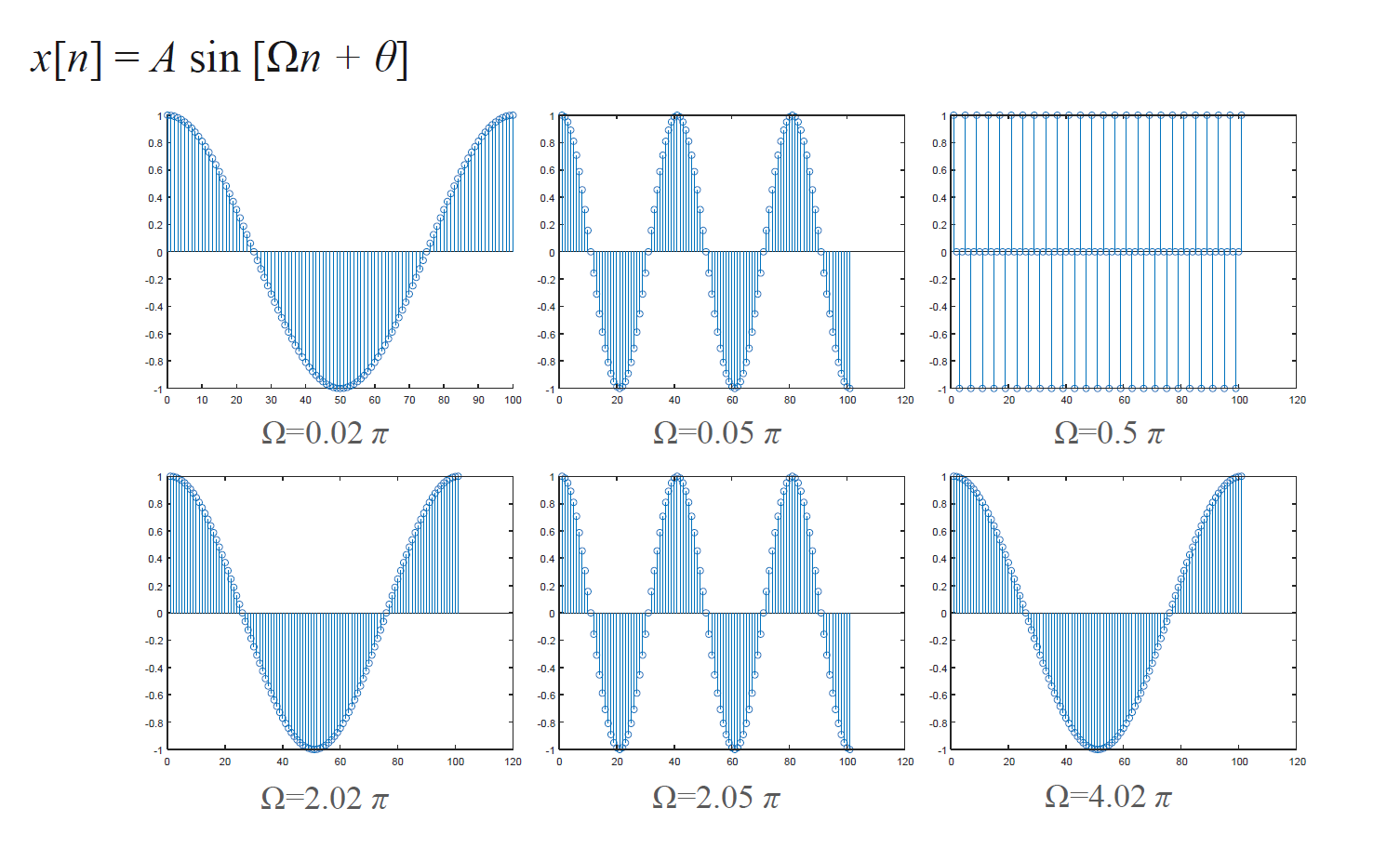
- As $\Omega$ increases, the samples miss the faster oscilllatory behavior
Complex exponential signals
- CT : $x(t) = Ce^{st} = Ce^{(\sigma+j\omega) t}$
- DT : $x[n] = Ce^{sn} = Ce^{(\sigma+j\omega) n}$
- By euler’s equation, complex exponential and sinusoidals can be thought of as almost the same thing
- $\cos \theta = Re{e^{j\theta}}={e^{j\theta} + e^{-j\theta}\over 2}$
- $\sin \theta = Im{e^{j\theta}}={e^{j\theta} - e^{-j\theta}\over 2j}$
- $x(t) = Ce^{(\sigma + j\omega)t} = Ce^{\sigma t}(\cos \omega t + j \sin \omega t)$
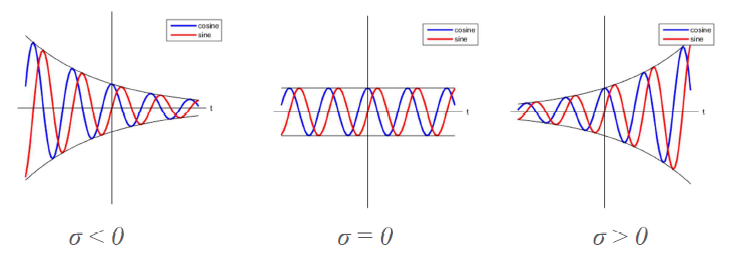
- Same things applied on DT
Periodicity of complex exponential term
- CT : $x(t) = x(t+T)$
- $e^{j\omega t} = e^{j\omega (t+T)}$
- Period $e^{j\omega T} = 1 \Rightarrow T={2\pi \over \omega}$
- DT : $x[n] = x[n+N]$
- $e^{j \omega n} = e^{j \omega (n+N)}$
- Period $e^{j\omega N} = 1 \Rightarrow N=m{2\pi \over \omega} \in \N$
Unit step function
- CT : $u(t) = \begin{cases}1, & t\geq 0 \ 0, & t<0\end{cases}$
- DT : $u(n) = \begin{cases}1, & n\geq 0 \ 0, & n<0\end{cases}$
Unit impulse
- DT : $ \delta[n] = u[n]-u[n-1]$ ( Kronecker delta)
- $\delta[n] = \begin{cases} 1, & n=0 \ 0, & n\neq 0 \end{cases}$
- while $m<0$, $\delta[\cdot]$ is zero for all $m$. $\delta[m]$ is $1$ only for positive $m$ ($0 \sim n$)
- $m=-\infty$ for considering negative $n$
- DT : $\delta (t) = \lim_{\Delta\to 0}\delta_{\Delta}(t)$
- $\delta(t) = \begin{cases}+\infty, & t=0 \ 0, & t \neq 0\end{cases}$
Sampling as product with unit impulse
\[\begin{aligned} x[n]\delta[n-n_0] = x[n_0]\delta[n-n_0] \\ \sum_{n=-\infty}^\infty x[n]\delta[n-n_0] = x[n_0] \end{aligned}\]- Sample at $n=n_0$ with $\delta[n-n_0]$
Operation on signals
- Amplitude scaling : $H : x(t) \rightarrow y(t) = Kx(t)$
- Time translation : $H : x(t) \rightarrow y(t) = x(t-t_0)$
- $t\leftarrow t-t_0$
- Time scaling : $H : x(t) \rightarrow y(t) = x(t/a)$
- $t\leftarrow t/a$
- $a>1$ : stratch the time domain
- $0<a<1$ : shrink the time domain
- $a=-1$ : time reverse
- The order of operation matters.
This post is licensed under CC BY 4.0 by the author.