[신호 및 시스템] Lec 08, 09 - Continuous/Discrete Time Fourier Series
[신호 및 시스템] Lec 08, 09 - Continuous/Discrete Time Fourier Series
Precaution
본 게시글은 서울대학교 박성준 교수님의 신호 및 시스템 (26 Spring) 강의록입니다.
Periodic signals and harmonics
- consider $x(t)$ with fundamental period $T$ (Fundamental frequency $\omega _0 = {2\pi \over T}$)
- Harmonics : complex exponentials (or sinusoids) whose frequencies are integer multiples of the fundamental frequency
- $\phi_{c, k}(t) = e^{jk\omega_0 t} = e^{jk{2\pi\over T} t}, k=0, \pm 1, \pm 2 , \cdots$
- Harmonic representations : Periodic signals can be represented as a sum of harmonics
Fourier series representation
- Mathematical property for finding $a_k$
CT Fourier Series
- Analysis
- Synthesis
Dirichlet conditions for pointwise convergence
- There is no energy in the difference $\int_T \vert e(t)\vert^2 dt = 0$ where $e(t) = x(t) - \sum_{k=-\infty}^{\infty} a_k e^{j k \frac{2\pi}{T} t}$
- if $\int_T \vert x(t)\vert^2 dt < \infty$ ($x(t)$ has finite energy per period)
- Condition 1 : $x(t)$ is absolutely integrable over one period, i.e.
- Condition 2 : In a finite time interval, $x(t)$ has a finite number of maxima and minima.
- $x(t) = \sin (2\pi /t)$ : Violates condition 2
- Condition 3 : $x(t)$ has only a finite number of discontinuities
- The fourier series : “midpoint” at points of discontinuity
Fourier Series
Mean value
\[a_k = \frac{1}{T} \int_0^T x(t)e^{-j k \omega_0 t}\,dt \Rightarrow_{k=0} a_0 = \frac{1}{T} \int_0^T x(t)\,dt\]Constant ↔ Impulse
- Scalar constant
- $A \xLeftrightarrow{\mathrm{FS}} A\delta[k]$
- Periodic impulses
- $\sum_{n=-\infty}^{\infty} \delta(t - nT)\xLeftrightarrow{\mathrm{FS}}\frac{1}{T}$
Time & Frequency Shift
- Time shift
→ $t \leftarrow t-t_0$ : Follows the original sign
- Frequency shift
→ $k \leftarrow k-k_0$ : reverses the original sign
Differentiation & integration
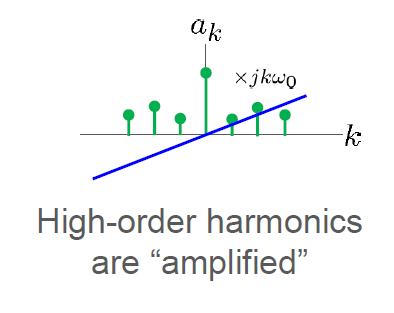
- Differentiation
- $jk\omega_0$ omits.
- Geometrical Interpretation : Higher-order harmonics are amplified
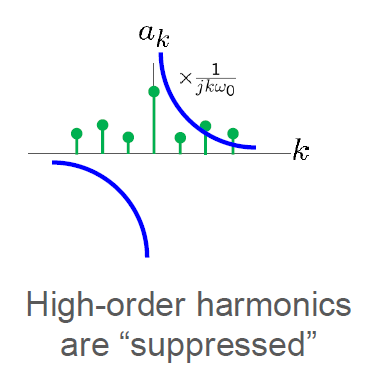
- Integration
- $1/jk\omega_0$ omits.
- Geometrical interpretation : Higher-order harmonics are suppresed
Flip
\[\tilde{x}_T(-t)\xLeftrightarrow{\mathrm{FS}}a_{-k}\quad (= a_k^* \text{ for real } \tilde{x}_T(t))\] \[\tilde{x}_T(-t)= \sum_{k=-\infty}^{\infty} a_k e^{-j k \omega_0 t}= \sum_{k=-\infty}^{\infty} a_{-k} e^{j k \omega_0 t}\]- Fourier coefficient also flipped
- Application to even, odd function :
- Even function $\tilde{x}T(-t) = \tilde{x}_T(t) \xLeftrightarrow{\mathrm{FS}} a{-k} = a_k$
- Odd function $\tilde{x}T(-t) = -\tilde{x}_T(t) \xLeftrightarrow{\mathrm{FS}} a{-k} = -a_k$
- Even → Even, Odd → Odd : Even odd property still remains
Time scaling
\[\tilde{x}_T(\alpha t)\xLeftrightarrow{\mathrm{FS}}a_k\quad (\omega_0 \rightarrow \alpha \omega_0)\] \[\tilde{x}_T(\alpha t)= \sum_{k=-\infty}^{\infty} a_k e^{j k \omega_0 \alpha t}= \sum_{k=-\infty}^{\infty} a_k e^{j k (\alpha \omega_0) t}\]- For coefficient $\alpha$ affects the frequency, not the coefficient directly
- for $\alpha>1$, shrinking the original function works as multiplication of same factor to frequency
Conjugate symmetric
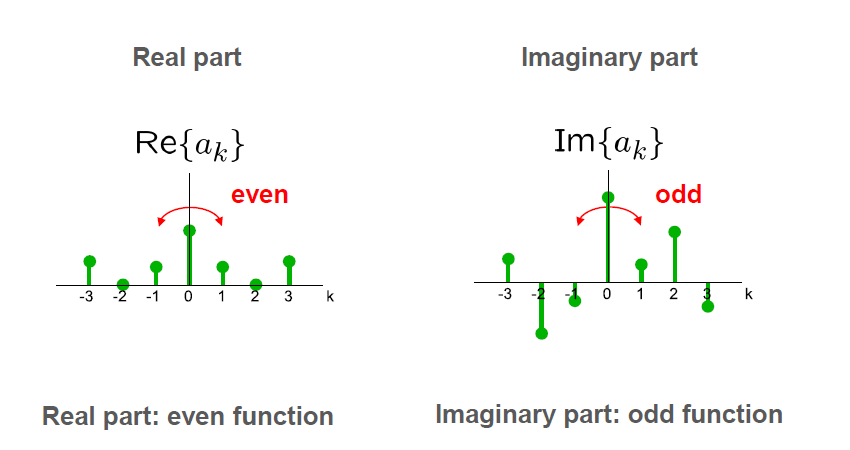
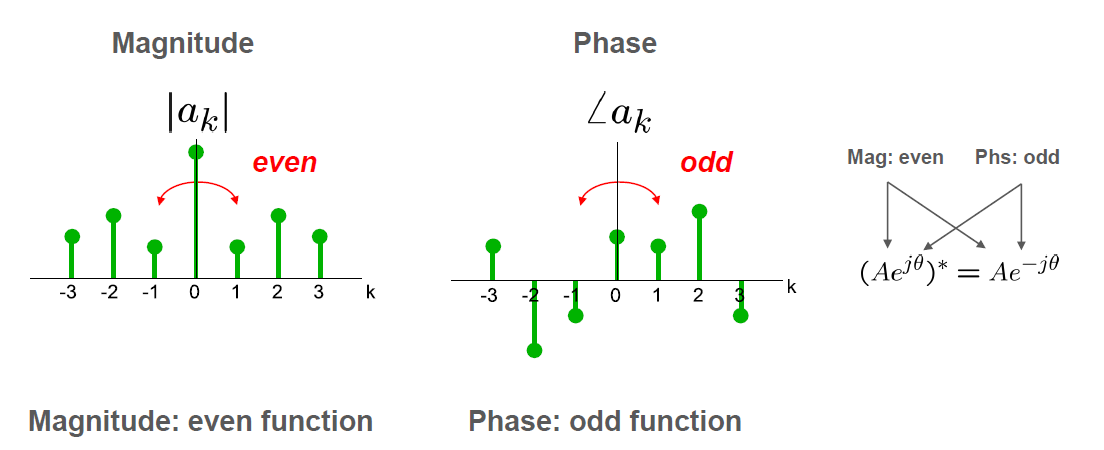
- If $x(t)$ is real, then $a_{-k} = a_k^$ and $a_k = a_{-k}^$
- Which means, the real part of $a_k$ of real function is even, while odd part of $a_k $ is odd.
- Interpretation as a complex exponential function, in terms of magnitude → even function, phase → odd function
Complex conjugate : Conclusion
- $x(t)$ is real, even → $a_k$ are conjugate even and even → $a_k $ are real, even.
- $x(t)$ is real, odd → $a_k$ are conjugate even and odd → $a_k$ are pure imaginary, odd
Multiplication
$\tilde{x}_T(t)\xLeftrightarrow{\mathrm{FS}}a_k,\tilde{y}_T(t)\xLeftrightarrow{\mathrm{FS}}b_k$
\[\tilde{x}_T(t)\tilde{y}_T(t)\xLeftrightarrow{\mathrm{FS}}\sum_{m=-\infty}^{\infty} a_m b_{k-m}\]- Multiplication → convolution
Convolution
$\tilde{x}_T(t)\xLeftrightarrow{\mathrm{FS}}a_k, \tilde{y}_T(t)\xLeftrightarrow{\mathrm{FS}}b_k$
\[\tilde{x}_T(t) * \tilde{y}_T(t)\xLeftrightarrow{\mathrm{FS}}T a_k b_k\] \[\begin{aligned} \tilde{x}_T(t) * \tilde{y}_T(t) &= \int_0^T \left[\sum_{m=-\infty}^{\infty} a_m e^{j m \omega_0 \tau} \sum_{n=-\infty}^{\infty} b_n e^{j n \omega_0 (t-\tau)}\right] d\tau \\ &= \sum_{m=-\infty}^{\infty} \sum_{n=-\infty}^{\infty} a_m b_n \left(\int_0^T e^{j (m-n)\omega_0 \tau} d\tau\right) e^{j n \omega_0 t} \\ &= \sum_{m=-\infty}^{\infty} \sum_{n=-\infty}^{\infty} a_m b_n (T\delta_{mn}) e^{j n \omega_0 t} \\ &= \sum_{n=-\infty}^{\infty} T a_n b_n e^{j n \omega_0 t} \end{aligned}\]- by the property of Fourier series (intergrate over one period) → $T$ omits
Parseval’s relation
\[\frac{1}{T}\int_T |\tilde{x}_T(t)|^2 dt=\sum_{k=-\infty}^{\infty} |a_k|^2\]- Average power over one period = Total squared sum of fourier series coefficient
Example : periodic rectangular function
| $\mathrm{rect}(t) =\begin{cases}1, & | t | \le 0.5 \0, & | t | > 0.5\end{cases}$ |
DT Fourier Series
- Analysis
- Synthesis
Linearity, time-frequency shift
- Time shift
- Frequency shift
Convolution, multiplication
- (Periodic) Convolution
$\tilde{x}_1[n]\xLeftrightarrow{\mathrm{FS}}a_k,\tilde{x}_2[n]\xLeftrightarrow{\mathrm{FS}}b_k$
\[\tilde{z}_N[n]= \sum_{k=\langle N \rangle} \tilde{x}_N[k]\tilde{y}_N[n-k]\xLeftrightarrow{\mathrm{FS}}c_k = N a_k b_k\] \[\tilde{z}_N[n]= \tilde{x}_N[n]\tilde{y}_N[n]\xLeftrightarrow{\mathrm{FS}}c_k = \sum_{l=\langle N \rangle} a_l b_{k-l}\]- In case of convolution, $N$ omits
Difference, running sum
- Difference
- Just summation of original FS + time shift FS
- Running sum
- Work as infitnite sum of series with $r = e^{-jk\Omega_0}$
Time-scaling
\[\tilde{x}_{mN}[n] =\begin{cases}\tilde{x}_N[n/m], & \text{if } n/m \text{ is integer} \\0, & \text{otherwise}\end{cases}\xLeftrightarrow{\mathrm{FS}}\frac{1}{m} a_k\]- Works conversely : for CT $x(t) \rightarrow x(\alpha t)$ but in case of DT $x_N[n] \rightarrow x_{mN}[n]=x_N[n/m]$
- for $m>1$, stretches the signal, and fills the hole with zero
Conjugate symmetric
- If $x_N[n]$ is real, then $a_{-k} = a_k^$ and $a_k = a_{-k}^$
Parseval’s relation
\[\frac{1}{N} \sum_{k=\langle N \rangle} |\tilde{x}_N[n]|^2=\sum_{k=\langle N \rangle} |a_k|^2\] This post is licensed under CC BY 4.0 by the author.