[C++] Chap 03 - Functions
[C++] Chap 03 - Functions
Functions
- A function can have any finite number of arguments of varying data types / No function has more than one value returned (One or zero)
- Predefined functions :
#import <cmath>,sqrt(x),pow(x, i),fabs(x),floor(x),ceil(x),round(x)
Random number generator
rand(): takes no arguments, returns a uniform random integer btw 0 & RAND_MAX#includ <cstdlib>srand(): seed
Time
#include <ctime>- to return current time (elapsed in seconds since 1970.01.01) :
time(NULL)
Components of Function Use
- Function declaration / Prototype
- Function Definition (implementation)
- Function Call
Function Declaration / Prototype
1
2
3
4
<rtn_type> FcnName(<formal-param-list>);
double totalCost(int num, double price);
// or
double totalCost(int, double);
- Designates the type of the
“return val”,“name of func”,“number of arguments”,“type of formal parameters” - Placed before any calls to the function (above the main)
- Formal parameter names are not needed : can only present data types of params.
Function definition
- Entire implementation of function is called function definition, lines inside the bracket is called function body.
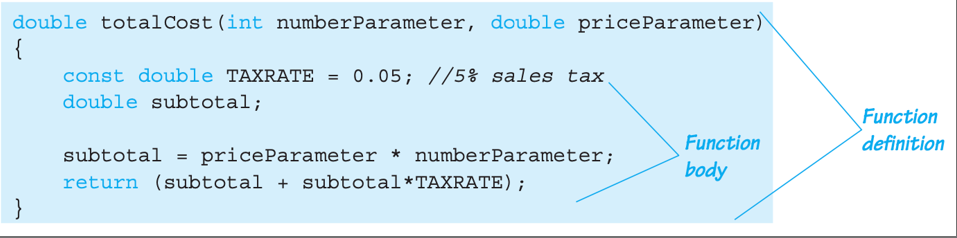
- Can be placed after or before the main function.
- In case of before, function declaration can be omitted
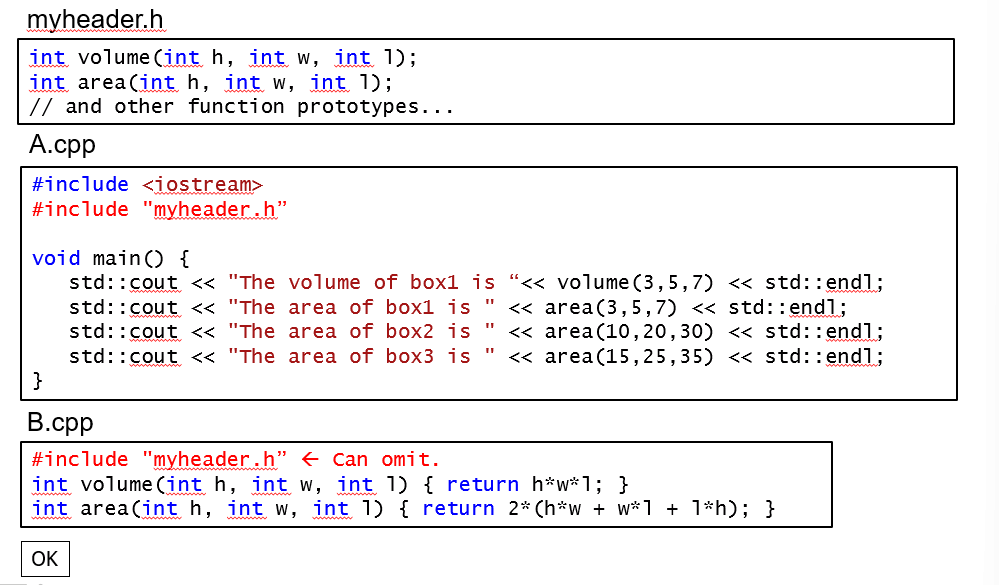
- Can also be placed in a seperate file (another .cpp or for declaration, .h or .hpp)
- Functions are equal, no function is a ”part” of another.
- (formal) Parameters : Memory placeholders for data sent in
Function call
- Arguments at function call : actual arguments
- Function arguments can be literals, variables, expressions, or their combination
Simple example : multiple cpp files and header
Parameter vs Argument
- Often used interchangably but technically param is “formal” piece while argument is “actual”
- Formal (params/args) : in function declaration, header
- Actual (params/args) : in function call
Return statement
- return is optional statement for void function ( Closing bracket
}implicitly return control from void function) - Return type other than void MUST have return statement. (except for
main())
Main
- Operating system calls main()
- should return int or void
- omitting return in
main()is possible
Scope rules
- Local variables : declared inside the body of given function / available only within that func.
- Global variables : if declared outside function body
- Global constants :
const double TAXRATE=0.05;Declared globally so all functions can use it. - variables declared with
constinside the function is also follows scope rules
This post is licensed under CC BY 4.0 by the author.