[C++] Lab2 - STL
[C++] Lab2 - STL
Automatic Type Deduction
- A keyword ‘auto’
- Compiler infers the variable’s type.
- Works with the return value from function
- Cannot be used without initialization
- Cannot be as a parameters of functions (before c++20)
- For some application, used for shortand type def (
vector<int>::iteratoretc.. ) - A keyword
decltype- Inspects the declared type of an entity
1
2
3
4
auto a = 2; //int
decltype(a) b = 3; //int
decltype(a+b) c = a+b; //int
auto d = sqrt(a*a+b*b); //double
Tuple
- An object that can hold a collection of elements
- Each elements can be a different type
1
2
3
4
std::tuple<type1, type2, ...> NAME;
//syntax
NAME = std::tuple<type1, type2,...>(val1, val2, ...);
//assignment
- Declaration :
std::tuple<type1, type2, ...> NAME; - Assigning tuple with values :
make_tuple(val1, val2, ...); - Accessing to value :
get<index>(NAME);
1
2
3
4
5
tuple<int, int> division(int a, int b) {
	return make_tuple(a/b, a%b);
}
auto result = division(7, 3);
cout<< get<0>(result)<<get<1>(result)<<endl;
- Return a number of elements in tuple :
tuple_size<decltype(NAME)>::value - Concatenate tuples :
tuple_cat(tuple1, tuple2, , ...);
STL in modern C++ : Introduction
- Sequence Containers : Data structures which can be accessed in a sequential manner
- array, vector …
- Iterators : Used as a pointer to point at the memory address of STL
begin(), end(), next(), prev()…
- Algorithms : Sort, search …
Array
- Container with fixed storage size
- Array class knows its own size
- Stored in stack area
array<DATA_TYPE, SIZE> name = {value1, value2, ..., valueN};at, [], front, back, data, begin, end, rbegin, rend, empty, size, fill, swap
Iterator
- Point the memory addresses from STL containers
- Value in iterator can be accessed by
*operator - Data stored at array :
arr.begin() ~ arr.end()-1
Algorithm
sort(first_iterator, last_iterator): sort the given arrayreverse(first_iterator, last_iterator): reverse an arrayfind(first_iterator, last_iterator, value): find an iterator with given value- Not a member function, find returns iterator
1
2
3
4
sort(arr.begin(), arr.end());
auto it = find(arr.begin(), arr.end(), 4);
cout <<*it<<endl; //4
reverse(arr.begin(), arr.end());
Vector
Containers
- Create and store data and objects
- Sequence containers : array, vector
- Container adopters : stack, queue
- Associative container : set, map
- Vector : Storage of vector is handled automatically (expanded, contracted as needed)
- Possible to insert or erase data
vector<DATA_TYPE> NAME;vec.push_back(value): pushes the elements into a vector from the backvec.begin(),vec.end()vec.resize(n): resizes to given value, capacity remainsvec.shrink_to_fit(n): make capacity to given value
1
2
3
4
5
int sum = 0;
while (!vec.empty()) {
	sum+=vec.back();
	vec.pop_back();
}
vec.insert(iterator, val): inserts given val into pos itervec.erase(iterator): erases value at given pos itervec.clear(): clears the vec. size becomes 0
Sorting
- use
sort(begin(), end());
Search : binary search
- Given sorted array, find given value
- O(log n)
1
2
3
4
5
6
7
8
9
10
11
12
function binary_search(A, n, T) :
	L=0
	R=n-1
	while L<=R do
		m=floor(L+R/2)
		if A[m]<T :
			L=m+1
		else if A[m]>T:
			R=m-1
		else :
			return m
	return unsuccessful
- Can easily be implemented with iterator
Set
- Associative container that stores unique elements following a specific order
- Ordered, Unique keys
set <DATA_TYPE> NAME;: default with less(ascending order) - Syntax with compare class :
set <data_type,compare> name;
1
2
3
4
5
6
set<int> a = {60, 20, 40, 10};
// 10, 20, 40, 60
set<int, greater<int>> b (a.begin(), a.end());
// 60, 40, 20, 10
b.erase(b.begin(), b.find(40));
// 20, 10
set.lower_bound(const g): first element ≥ gset.upper_bound(const g): first element > g
1
2
3
set<int> s1 = {10, 20, 30, 40, 60};
s1.lower_bound(40); // 40
s1.upper_bound(40); // 60
find(val): find given value in the set. if not exists, return end()
Map
- Combination of key-value pair following a specific order
- Key to mapped value
- Unique keys
map<data_type_of_key, data_type_of_value> map_name;map.insert(pair<int, int>(val,val));: inserts given key. override not workingm[i]=j;: Overriding worksmap.count(key): if key exists return 1, else 0map.lower_bound(g),map.upper_bound(g), copy constructor all works same with set
Stack
- LIFO(Last in first out)
stack<data_type> name;Definitionstk.empty()checks if the stk is emptystk.top(),stk.push(val)Accesses the top value, push given valstk.pop()pops out the last value
Container of Container
- Hierarchical container structure
1
2
3
4
5
map<string, stack<int>> animals;
vector<string> animal_name = {"cat", "dog", "cow", "horse"};
for (auto elem : animal_name)
	animals.insert(make_pair(elem, stack<int>()));
animals["cat"].push(1);
Container of Pointer
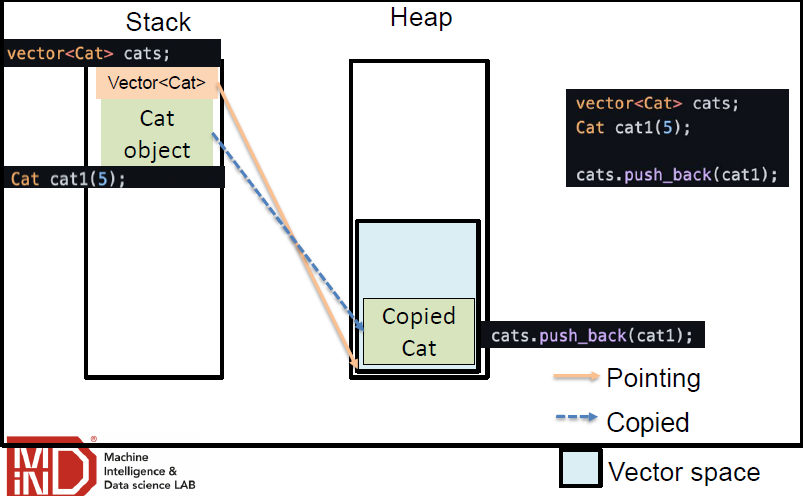
- Container including vector stores data by value,
1
2
3
4
5
6
7
8
9
vector<Cat> cats;
Cat cat1 = Cat(5);
cats.push_back(cat1);

cat1.getAge();
cats[0].getAge(); //surely, 55
cat1.setAge(3);
cat1.getAge();
cats[0].getAge(); // 35 because vector copies cat
1
2
3
4
5
6
7
8
9
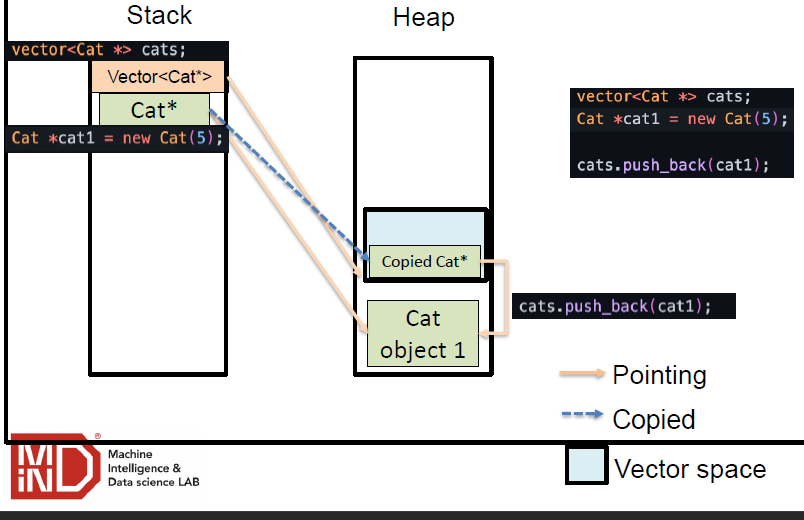
vector <Cat*> catsptr;
Cat* pcat1 = new Cat(5);
catsptr.push_back(pcat1);

pcat1->getAge();
catsptr[0]->getAge(); //55
pcat1->setAge(3);
pcat1->getAge();
catsptr[0]->getAge(); //33 this time
- Vector copies the object to the heap space
This post is licensed under CC BY 4.0 by the author.