[유체] Chap 11. Basics of Viscous Flow
Chap 11. Basics of Viscous Flow
11.1 Definitions
\[\tau = \mu {\partial u \over \partial y}\]- If $\mu $ is constant, it is Newtoninan fluid
- Newtonian fluid : a fluid in which the viscous str ess are linearly correlated to the local strain rate
- In einstein notaiton
Stress tensor
\[\sigma _{ij} = -p\delta_{ij} + \tau_{ij}\]- in Vector Notation
- $\mu$ : dynamic viscosity, ($kg/m\cdot s$)
- $\nu$ : kinematic viscosity, ($m^2 /s$)
11.2 Key nondimensional Parameter in Viscous Flow
\[F = ({\vec \sigma \cdot \vec n})ds\]- Reynolds Number
- Ratio between inertia force and viscous force
- Low Reynolds number : Viscosity dominent(Laminar) , High Re : Inertia dominent (Turbulant)
- Drag coefficient
- $S$ : in general, projected area, in ship, Wetted Surface Area
- Drag consists of Friction al Drag($C_f, \tau_{ij}$) + Pressure drag ($p\delta_{ij}$)
Kinematic Condition
- No-penetration condition : $u_n = 0$ or $u_n = U\cdot \vec n$
- No-slip condition
- Free slip condition on potential flow ($u_t \neq 0$) no necessary to be zero
- Flow seperation happens on ${\partial u \over \partial y} = 0$
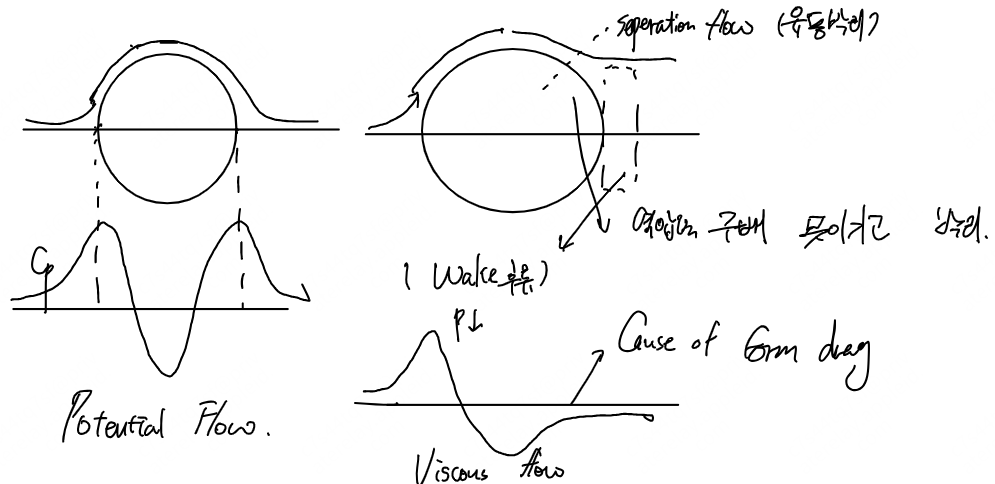
- $C_p = {P \over {1\over 2 } \rho u^2}$
Cylinder (Laminar vs Turbulant)
- All viscous flow : thus seperation always happens
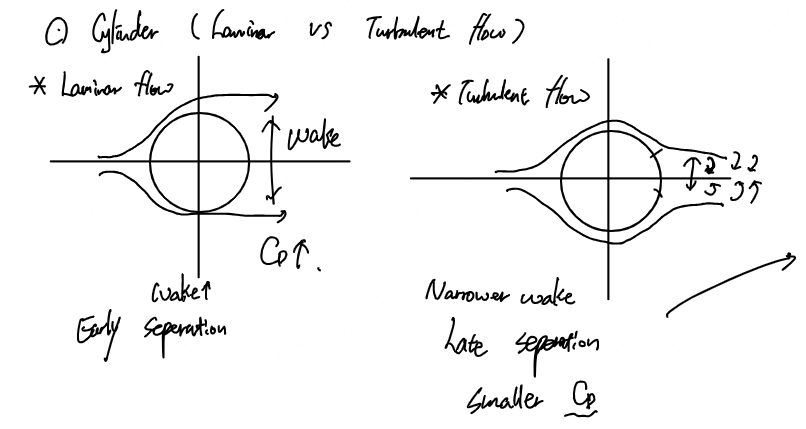
- Reasons of making dimple on golf ball. Turbulance makes late seperation, which causes smaller $C_D$
- Ideal flow : $Re = \infty$ as $\nu \to 0$ → No seperation happens
11.3 Differential Equations for viscous flow
- Remind : Euler equation and its derivation
and $\sigma_{ij} = -p\delta_{ij} + \tau_{ij}$
\[\nabla \cdot \sigma_{ij} = {\partial \sigma_{ij} \over \partial x_j} = {\partial (-p\delta_{ij})\over \partial x_j}+ \mu {\partial \over \partial x_j} \big({\partial u_i\over \partial x_j} + {\partial u_j \over \partial x_i}\big)\] \[= -\nabla p + \mu\nabla^2 u_i + ({\partial \over \partial x_i})\cancel{({\partial u_j \over \partial x_j})}\]- In vector Notation
11.4 Examples of Exact solutions of N-S equation
Flow between two plates : Couette flow
Upper plate moves to x-dirextion with constant velocity $U$
Lower plate stays still, gap between two plate is $h$
- BVP
- Boundary condition
$u=U, v=0 $ on $y=h$ (No-slip, no-penetration condition)
$u=0, v=0$ on $y=0$ (Same)
${\partial \over\partial x} (u, v) = 0$ (No velocity profile change in x-direciton, assumption of Couette flow)
Steady flow : ${\partial \over \partial t}(\cdot ) = 0$
- Governing Equations
⇒ ${\partial v \over \partial y} = 0$, $v(y) = 0 (v(0) = v(h) = 0)$
\[\cancel{\partial u \over \partial t } + u\cancel{\partial u \over \partial x} + \cancel{v{\partial u \over \partial y}} = -{1\over \rho}{\partial p \over \partial x} + \cancel{ \vec f} + \nu \big(\cancel{\partial^2 u \over \partial x^2} + {\partial ^2 u \over \partial y^2}\big)\] \[{\partial p \over \partial x} = \mu {\partial^2 u \over \partial y^2}\] \[\cancel{\partial v \over \partial t } + u\cancel{\partial v \over \partial x} + v\cancel{\partial v \over \partial y} = -{1\over \rho}{\partial p \over \partial y} + \cancel{ \vec f} + \nu \big(\cancel{\partial^2 v \over \partial x^2} + \cancel{\partial ^2 v \over \partial y^2}\big)\] \[{\partial p \over \partial y} = 0\]- By integration
Applying Boundary conditions, $C_2 = 0$
\[C_1 h = U-{1\over 2\mu} ({\partial p \over \partial x})h^2\] \[C_1 = {U\over h} - {h\over 2\mu} {\partial p \over \partial x}\] \[\therefore u = {1\over 2\mu} (y-h)y {\partial p \over \partial x} + {U\over h}y\] \[\tau_{xy} = \mu ({\partial u \over \partial y}) = \mu {U\over h}+ {\partial p \over \partial x}(y-{h\over 2})\]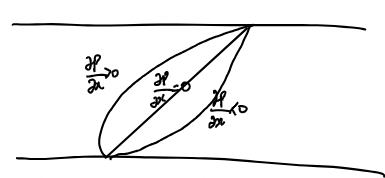
Flow inside a pipe : Poiseulle Flow
- Axi-symmetric flow, $\vec u = (u_x, u_r, u_\theta) = (u_x, 0, 0)$
- Useful Formula in cylenderic / polar coordiante
- Continuity eqn
- N-S eqn
Integrate,
\[u = {1\over 4\mu}(-{\partial p \over \partial x})(R^2-r^2)\]- BC : $u=0, r=R, u\neq \infty, r=0$
- Perspective of wall, coordinate is defined
11.5 Turbulant flow and RANS equation
- Laminar flow :
- Layer flow
- Weak mixing
- Little fluctuation velocity
- Viscous-dominant flow Smaller Re
- Getting Damped motion
- Turbulant flow :
- Chaotic particle flow
- Strong mixing
- Non-ignorable fluction
- Higher Re
- Getting growing motion
- Assume that
- $\overline{u_i’} = 0$
- $\overline{u_i u_j} = \overline{(\overline{u_i}+u_i’)(\overline{u_j}+u_j’)} = \overline{u_i}\overline{u_j} + \overline{u_i’}\overline{u_j’}$
Continuity equation
\[{\partial u_i \over \partial x_i} = \cancel{\partial \overline{u_i}\over \partial x_i} + {\partial u_i'\over \partial x_i} = 0\]Navier-stokes equation
\[\overline{\partial u_i \over \partial t}+ \overline{u_j{\partial u_i \over \partial x_j}} = -{1\over \rho}{\partial p \over \partial x_i} + f_i+ \overline{\nu \nabla^2 u_i}\]- Convection velocity term
The last term
\[\overline{u_j' {\partial u_i'\over \partial x_j}} = \overline{{\partial \over \partial x_j}(u_j'u_i')}-\cancel{\overline{u_i'{\partial u_j'\over \partial x_j}}}\]Reynolds Averaged- N.S Equation; RANS eqn
\[{\partial \overline{u_i}\over \partial t} + \overline{u_j}{\partial \overline{u_i} \over \partial x_j} = f_i + {1\over \rho} {\partial\over \partial x_j}(\sigma_{ij}-\rho\overline{u_i'u_j'})\]Where
\[\tau_{R, ij} = -\rho \overline{u_i'u_j'}\]is Reynolds stress : Aveaged stress caused by perturbation
- 7 Unknowns($p, u, v, w, \overline{u, v, w}$), 4 equations(Continuity + N.S.)
- Additional Turbulance modeling required to compensate for missing unknowns.
11. 6 Boundary Layer : Overview
Definitions of Boundary Layer
- A small area or region that viscosity dominates or influences
- BVP of thin boundary layer theory
Governing Equations
- Continuity eqn
- N.S with ${\partial p \over \partial y} = 0$
Boundary condition
- No-slip condition ($u=0, v=0$ on $y=0$)
- U, V potential flow velocity on far field $u=U, v=V$ on $y\to \infty$
Laminar vs Turbulant on Boundary layer
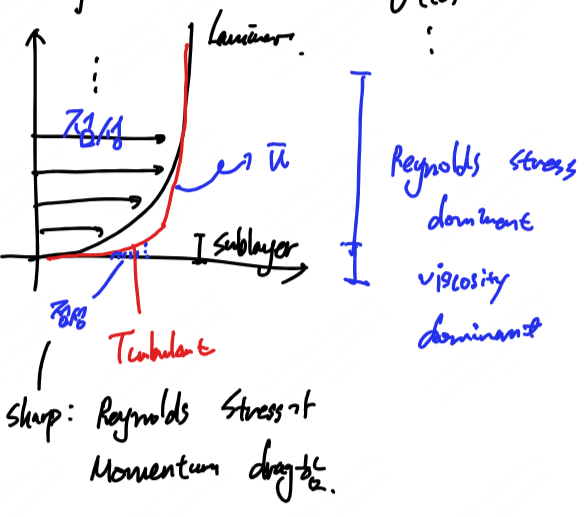
- A sharp sublayer exists on turbulant flow : Reynolds stress가 Momentum drag를 일으킴. → Viscosity가 dominant 한 영역을 줄여버림.
- Also, Turbulant boundary layer is Averaged line
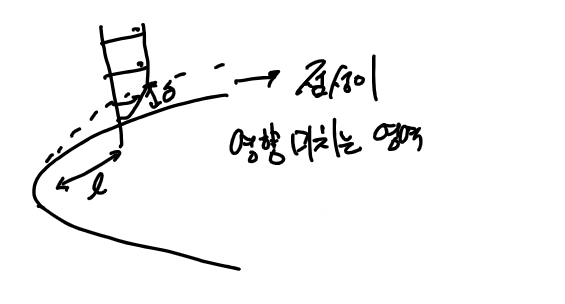
Dimensional analysis on Boundary Layer
- Define nondimensional variable
$x’ = x/l, y’= y/\delta, u’ = u/U, v’ = v/V$ : All nondimensional variables are order of one($\Theta(1)$)
Applying it to continuity eqn :
\[{u\partial u' \over l \partial x} + {v\partial v' \over \delta \partial y'} = 0\]$\Theta({U\over l}) = \Theta({V\over \delta}) $ →$\Theta({\delta \over l}) = \Theta({V\over U}) $
Whch means..
IF $U»V$, $\delta « l$. makes thin boundary Layer
Definitions of Threee Boundary layer thicknesses
- Boundary Layer thickness $\delta$ : $0.99u$에 도달하는 두께
- Displacement thickness $\delta ^*$ :
- Displacement thickness 만큼
- Momentum thickness $\theta$ :
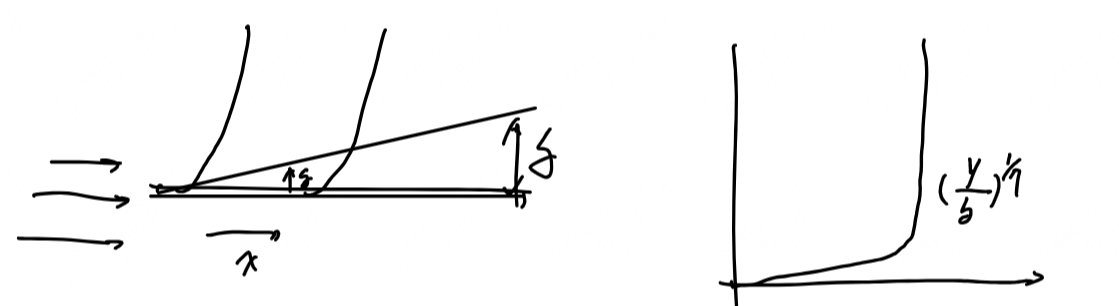
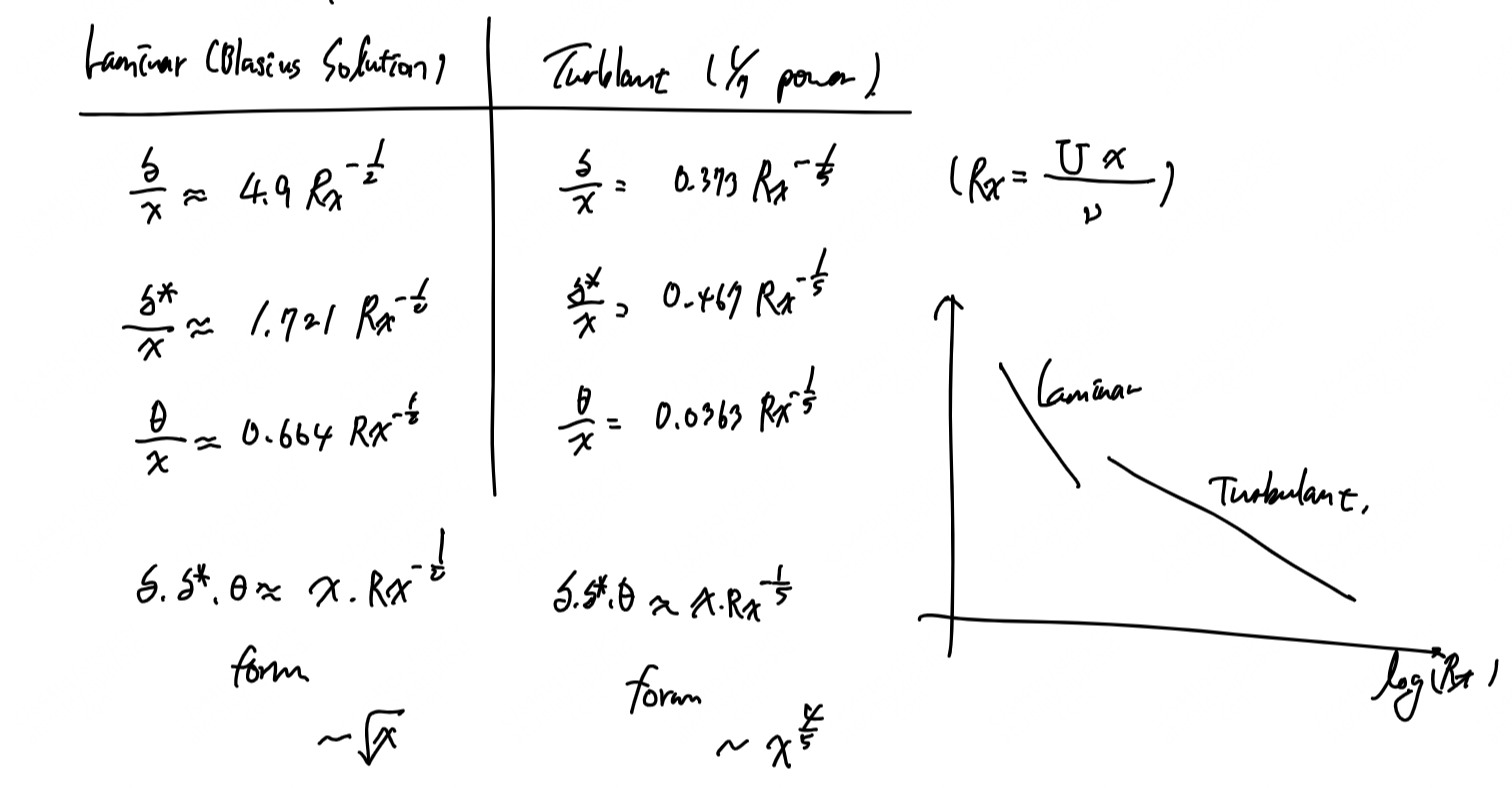
- Laminar condition, boundary layer thicknesses depends on 1/2 power of x
- In turbulant condition, thickness depends on 4/5 pwr of x
Skin friction coeff local
\[C_F = {\tau \over {1\over 2}\rho U^2}, C_{F,L} = 0.664Rx^{-0.5}, C_{F,T} = 0.0592Rx^{-0.5}\]skin friction coefficient depends on length x, so
\[{1\over L} \int_0^L C_F dx = C_{F, Mean}\]- Drag Force = Viscous drag + Residual drag
- Viscous drag = Friction drag on W.S. + form pressure drag