[C++] Chap 11 - Inheritance
[C++] Chap 11 - Inheritance
Inheritance Basics
Derived class
- said to “inherit” members from the base class
- Automatically has base class’s :
- Member variables
- Member functions
- Can then add additional member functions and variables
- Can redefine existing members and/or add add new members
1
class HourlyEmploee : public Employee // Publicly inherit
- Note its definition begins with
#ifndef: if the macro not defined, define . (same as #pragma once) - Derived class interface only lists ‘new’ or ‘to be redefined’ members (or overrides)
- Cannot omit
consttag in derived class basically (since it’s signature of function)
1
2
3
4
5
6
7
8
void HourlyEmployee::printcheck() {
	setNetPay(hour * rate); //Legal : setNetPay is function of parent class
	netPay = hour * rate; //Illeagl
	// Since the function modifies the member variable, must omit 'const'
	// two functions
	// Employee::printcheck() const;
	// HourlyEmployee::printcheck(); is considered differently
	// i.e. Not an override of one to another.
Inheritance Terminology
- Parent class (base class)
- Child class (derived class)
- Ancestor (Class that’s a parent of a parent)
- Descendant class (Opposite of ancestor)
Constructors of Derived Classes
- Base class constructors is NOT inhertited in derived classes
- But can be used in derived class constructor.
- Includes invocation of Employee class constructor
1
2
HourlyEmployee::HourlyEmployee( ... )
: Employee(theName, theNumber), wageRate(theWageRate), hours(theHours) {}
- Default version of base class constructor(no arguments)
1
2
HourlyEmployee::HourlyEmployee()
: Employee(), wageRate(0), hours(0) {}
- Derived class constructor should always invoke one of the base class’s constructors
- If not, Default base class constructor is automatically called
1
2
HourlyEmployee::HourlyEmployee()
: wageRate(0), hours(0) {} //Equivalent with the code above
- Order of constructor call : A→B→C : order when class C is created (Ancestor → Parent → Child )
Using Private Member Variables of the Base Class
- Derived class inherits private member variables
- It cannot directly access them by name, not even through derived class member functions
1
2
3
4
5
6
7
8
HourlyEmployee joe("Josephine", "1234", 0, 0);
joe.setName("Mighty-Joe"); //Possible since it uses parent's setter
joe.name = "Mighty-Joe"; //Illegal

void HourlyEmployee::accessName() {
	cout<<name; //Illegal since private member of parent class cannot be accessed
	//even through child class' function.
}
- Same holds for base class private member functions.
- Cannot be accessed outside (interface and implementation of the base class)
- Not even in derived class member function definitions. (Private member variables can be accessed indirectly via accessor or mutator memer functions of parent class, in constrast)
The protected
- Allows access by “name” in derived class
- It acts like private in defined class
- In derived class, considered protected to allow future derivations.
Redefining vs Overloading
- Different!
- Redefining in the derived class :
- SAME parameter list
- Essentialy re-writes the same function
- The signatures must be identical
- Overloading
- Different parameter list
- Defined “new” function that takes different parameters
- Overloaded function must have differnet signatures
Accessing Redefined Base function
- Specify scope to access redefined base function
1
2
3
4
5
Employee JaneE;
HourlyEmployee SallyH;
JaneE.printCheck(); // Empolyee::printCheck
SallyH.printCheck(); // HourlyEmployee::printCheck
SallyH.Employee::printCheck(); // Calls Employee's printcheck
Functions that are NOT inherited
- Constructors (but calls the base constructor when initializing derived class’s constructor parameter list)
- Destructor
- Copy constructor : but if not defined, generates the “default” one
- Assignment operator
- Assignment operator and copy constructors are NOT inherited but can be used in derived class definitions just like Constructor
Assignment Operator Example
1
2
3
4
5
Derived& Derived::operator = (const Derived& rightSide)
{
	Base::operator = (rightSide);
	...
}
- Calls assignment operator from base class, this takes care of all inherited member variables
- Would then set new vars from the derived class
Copy Constructor Example
1
2
3
4
Derived::Derived(const Derived& object) : Base(Object), <more_initializations>
{
...
}
- Invocate base copy constructor
- Object’s type is Derived, but it’s also type of Base, allowing it to make Base(Object)
Destructors in Derived Classes
- When derived class destructor is invoked, automatically cllas base class destructor → no need for explicit call
- Derived class destructors need only deal with derived class variables
- Destructor calling order : Opposite of how constructors are called
PFArrayDBak’s alternative implementation
1
2
3
4
5
6
void PFArrayDBak::backup()
{
	usedB = getNumberUsed();
	for (int i = 0;i<usedB;i++)
		b[i] = operator[](i); // same as this-> opeator[](i)
		//indirect access of a[i] using operator[] function
“Is a” versus “Has a”
- Inherit or have member class
HourlyEmployeeis anEmployee(is an child class of employee)Employeehas aDate(in member)
Protected and Private Inheritance
1
2
class SalariedEmployee : protected Employee
class SalariedEmployee : private Employee
- Protected : Public in base class → Protected in derived class (private → private)
- Private : All members in base class become private in derived class
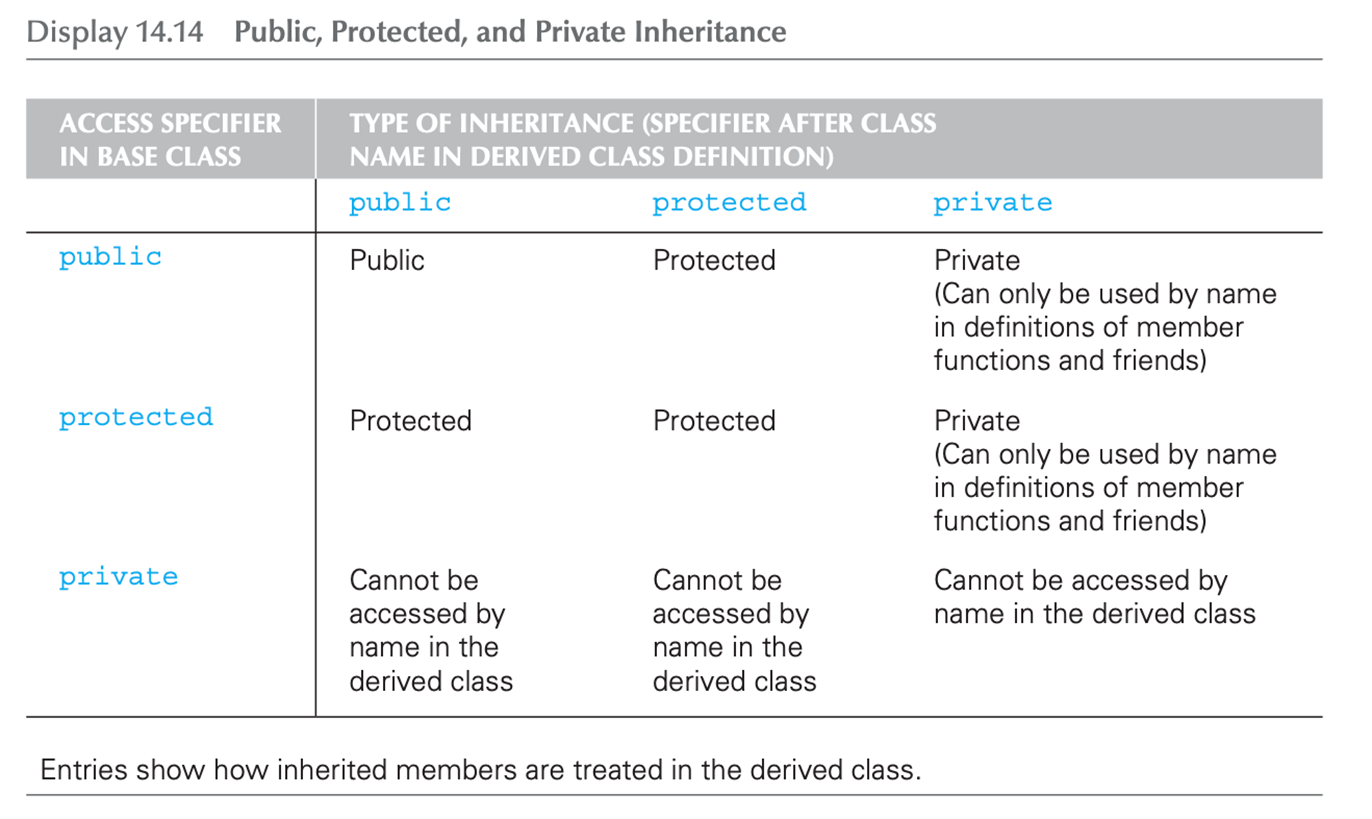
- The descendent of privatly inheited class cannot access ancestor’s public or protected function because it is defined as a private function in parent class
- It is considered as private → can access via functions but cannot access outside the class
1
2
3
4
5
6
7
8
9
10
11
12
class A {
public :
	void foo();
};
class B : private A {
};

B b;
b.foo(); //Illegal
A a;
a.foo(); //Legal
b.A::foo(); // Also illegal
Multiple Inheritance
1
2
class derivedMulti : public base1, base2 {}
//Defaulted to private : equivalent : public base1, private base2
This post is licensed under CC BY 4.0 by the author.